
Travelers search "poker rooms [your city]" at 6pm on a Friday. Here's how to make sure yours is what they find.

Most local card rooms are invisible in Google search.
A traveler in town for the weekend, a player who just moved in, a regular at the casino across town looking for a change. They all search the same way: "poker rooms [city]" or "card room near me." The operators who show up in those results capture a meaningful stream of one-off visits, and a handful of those visits turn into regulars. The setup is mostly free, it compounds over time, and most of your competition is not doing it.
This playbook walks through the specific moves: claim your Google Business Profile, tighten the on-page signals, emit the right structured data, publish a live schedule people can actually use, build your directory presence, and run the reviews loop. None of this is rocket science, but most local rooms do only one or two of the six and leave the rest on the table. (If you are earlier in the operational setup, see our operator's playbook.)
Claim and fill out your Google Business Profile
The local three-pack is driven by GBP, not by your website.
When someone searches "poker rooms [your city]," the first thing Google shows (above the organic results) is a map with three business listings. That three-pack is driven by Google Business Profile data. If you are not in the three-pack, you are competing for the scroll-past territory below it.
Claim it first
Go to google.com/business and walk through the verification flow. You need a physical address and a phone number. Google will send a postcard with a code, and occasionally offer phone or video verification. Plan on a few days.
Pick the right primary category
Card Room if Google lists it in your area. Otherwise Casino (the taxonomy is imperfect). Secondary categories: Entertainment Venue, Event Venue, Bar if you serve drinks.
Fill every field
Hours, address, phone, website link, short description, service area, amenities. Empty fields hurt ranking; complete listings outrank sparse ones in borderline cases.
Photos carry more weight than operators think
Exterior at night with the lights on. Interior with tables set up. A tournament in progress with a full room. Players enjoying themselves, with consent. Swap in fresh photos every few weeks. GBP rewards signals of an active, real-world business.
Post on a weekly cadence
GBP Posts are free real estate most rooms ignore. Post the weekly schedule every Monday. Post the tournament winner from last Saturday. Post the series announcement two weeks out. These appear in your listing, signal activity to Google, and give a traveler scrolling the three-pack a reason to tap yours.
Respond to every review within 24 to 48 hours
Google ranks listings that respond to reviews higher than ones that do not. More on the reviews loop in §6 below.
Put your city in the title, the H1, and the meta description
Put your city in the page title, the H1, and the meta description.
Google's local algorithm weighs these three signals heavily for city-level relevance. Most rooms use generic titles like "Home - My Card Room" that tell Google nothing about where the business is.
Page title format. For the homepage, use "[Room Name] - [City] Poker Room & Card Club." For interior pages, append the section: "[Section] - [Room Name], [City]." The city-plus-category combination is the specific phrase most of your target searchers type.
H1. Your homepage H1 should include the city. Natural phrasings work best: "Austin's Local Card Room," "Nashville Poker and Cash Games," "Scottsdale's Home for Weekly Tournaments." Avoid cramming multiple keywords into one H1; Google detects it and it hurts.
Meta description. Include the address, the stakes you spread, and the hours. Google often overrides the meta description in search results, but when it doesn't, a well-written one lifts click-through rate meaningfully.
URL structure. Keep URLs short and descriptive: /schedule, /tournaments, /membership. Not /page-id-42 or /index?section=3. Clean URLs are a small direct signal and a large signal when other sites link to them.
Canonical URLs. Every page should have a <link rel="canonical"> tag pointing to the preferred version. This prevents duplicate-content issues when URL parameters or trailing slashes create variants. Next Up Poker's site editor sets canonical URLs on every page automatically.
Emit the schema.org markup Google looks for
Structured data is invisible to visitors but critical to search engines.
It's the JSON-LD that tells Google: "this page is about a card room at this address, with these hours, running this tournament on Saturday, at this buy-in." The right schemas earn rich snippets (star ratings, hours, event details) in the search results. The wrong or missing schemas leave your page looking generic next to competitors whose schemas are dialed in. Reference docs for every schema type below live at schema.org.
LocalBusiness (homepage and contact page)
The most important schema for local search. Emit these fields:
name,address(street, city, state, postal code)geo(latitude, longitude)telephoneopeningHoursin the structured format (e.g."Mo-Fr 18:00-02:00, Sa-Su 14:00-03:00")priceRange(e.g."$$"or"$$$")url(your canonical homepage)image(link to a high-quality photo of the room)sameAs(array of links to your GBP, Yelp, Facebook, and any poker-specific directory listings)
Next Up Poker's site editor emits LocalBusiness schema from the room settings in the admin. Fill in the address, phone, hours, geo coordinates, and price range once, and the schema propagates to every page that should carry it.
Event (tournament pages)
Every tournament should have its own page, or at minimum its own schema entry, with Event markup: name, startDate, endDate, location (pointing to the LocalBusiness), offers (buy-in amount, currency, availability), description, and image. This is what earns your tournament its own appearance in Google's event-rich results, including the "Events" tab. Tournament pages generated through Next Up Poker's scheduler emit Event schema directly from the tournament data.
FAQPage (pages with FAQs)
If you have a FAQ on your homepage or a dedicated page, emit FAQPage schema. Rich snippets don't trigger on every page, but when they do, the payoff is a noticeably larger search result and a significantly higher click-through rate.
BreadcrumbList (interior pages)
Breadcrumbs in the search snippet raise mobile click-through noticeably and signal site structure to Google. Include them on every page below the homepage.
Article (/learn and editorial content)
If you publish operator-education or local-player content, emit Article schema with author, publishedDate, and image. Builds long-tail traffic.
Validate every schema you publish with Google's Rich Results Test before you rely on it.
Show which games are running right now
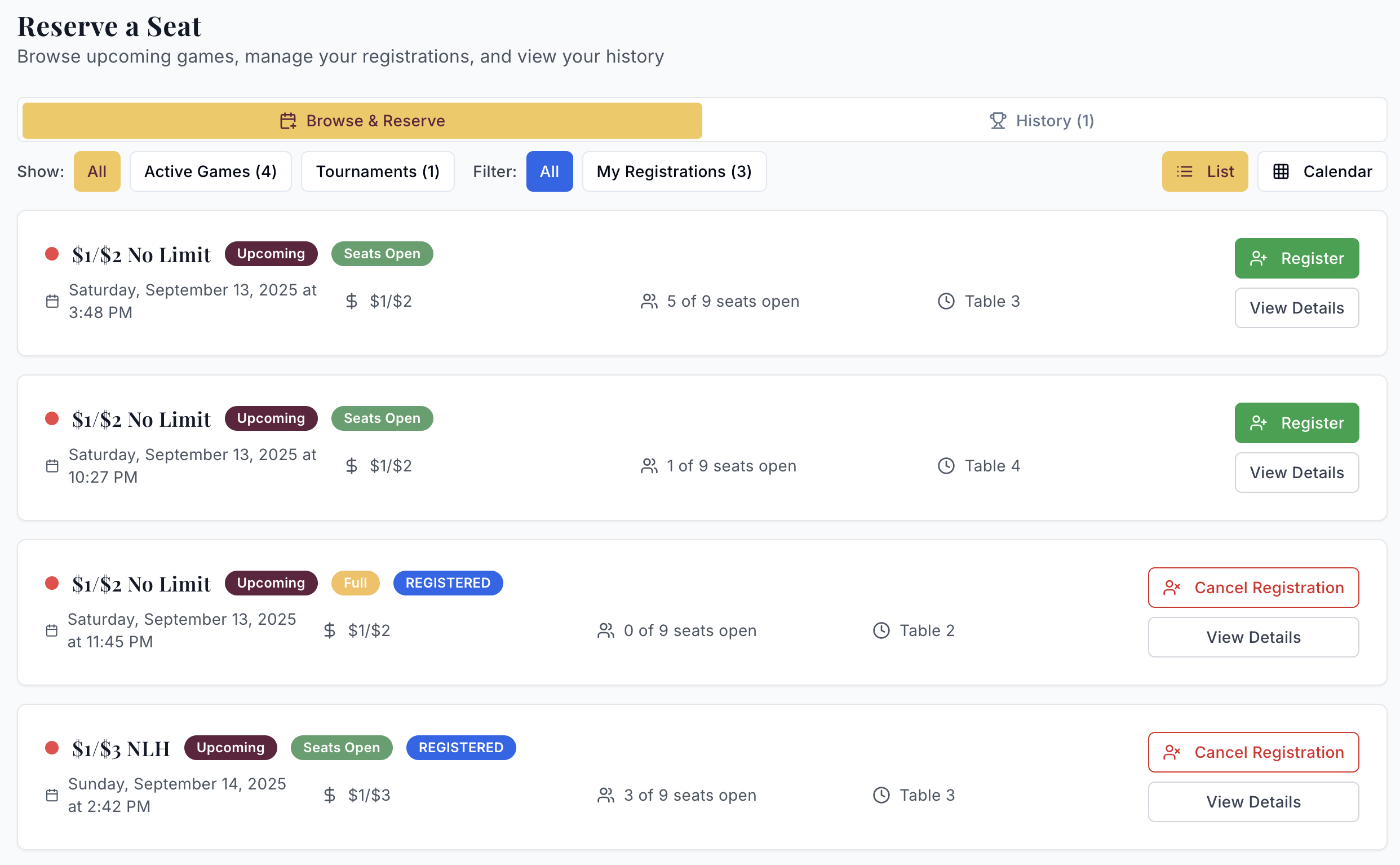
A traveler at 6pm Friday does not want a PDF from last month. They want to know if a seat is open right now.
This is the lever most local rooms leave on the table. A visitor who searches "poker rooms [your city]" and clicks through to your site wants to know if there is a $1/$2 seat open right now, and whether they can get there before the waitlist fills.
Weekly schedule, always current. The schedule page should update when you change the admin, not require a manual edit to a PDF or a static HTML block. Stale schedules are a trust-killer; a visitor who sees an outdated schedule assumes the room is closed or poorly run.
Live game indicators. Next to each scheduled game that is running right now, show a "Playing now" badge with a seat count: "$1/$2 NL, 2 seats open." That single signal collapses the friction of the "is it worth the drive" decision.
Game filters and stake displays. Let visitors filter by game type (NL, PLO, mixed) and stake level. Most searchers are looking for a specific stakes range and bounce if it takes three clicks to find out whether you spread their game.
Upcoming tournament countdowns. A "Starts in 2 hours" label on tonight's tournament pulls the visitor who was defaulting to the casino across town.
Next Up Poker publishes the live schedule and seat counts to your public site directly from the admin. The schedule a host sees when they are seating players is the same schedule a traveler sees when they are deciding whether to drive down. See Cash Game Management and Poker Room Website Builder.
Your name and address on every directory that matters
Your name, address, and phone (NAP) consistent across every directory that matters.
Google's local algorithm weighs citations heavily. A citation is a mention of your business on another site. More citations with consistent NAP signals a real, established business; inconsistent citations (one listing says "Suite 200," another says "Ste. 200") actively hurt.
Pick a canonical format. Write your name, address, phone, and hours exactly the way you want them to appear everywhere. That is the format you use on every directory, without exception.
The must-do directories. Google Business Profile (covered in §1). Yelp for Business. A Facebook Page for the room. Apple Business Connect for Apple Maps. Bing Places for Business.
Poker-specific directories. Poker Atlas is the largest community-maintained listing of card rooms and is worth the submission. Bravo Poker Live supports listings for rooms that want to publish their live game data to that audience. Both pass local-relevance signals to Google and bring their own steady trickle of searches.
Audit every six months. Search your room's name plus the city and check the first two pages of results. If a directory has a wrong address or an old phone number, correct it. Outdated listings drag your local ranking more than a single good listing helps.
Run the reviews loop
Recency matters more than most operators realize. 40 reviews from the last year beats 200 from 2022.
Reviews are the single biggest factor in local-pack ranking after GBP completeness and citation consistency. Quantity matters. Recency matters more.
Ask in person at cashout, not in mass emails. A brief "we really appreciate your business, a Google review helps us a lot if you have a minute" gets a review maybe one time in five. A mass email asking for reviews gets filtered as spam and converts at under 1%, and can trip Google's fake-review detection.
Make it easy. Generate a short-link to your Google review form from the GBP dashboard and print it on a card at the cashier station. "Scan to leave a review" with a QR code removes every friction step.
Respond to every review within 24 to 48 hours. On positives, thank the reviewer by name and reference the specific thing they mentioned. On negatives, acknowledge the issue, offer to talk offline, avoid defensiveness.
Never fake reviews or pay for them
Google's detection is aggressive and getting flagged tanks your listing for months. Offering discounts or freebies for reviews is against Google's TOS and risks the listing. Build the count honestly.
Google Search Console plus a monthly check-in
Free, ten minutes, and the only honest data on how Google sees you.
Set up Google Search Console for your site. Link it to the GBP dashboard. Once data flows, watch three things:
- Impressions on local queries. "poker rooms [your city]" and variations. How often do you show up in results? Grow this month over month.
- Click-through rate in the local pack. GBP Insights shows how often visitors click your listing compared to the other two in the pack. If yours is low, the photos, hours, or review count are likely weak.
- Review count growth. One new review a week is a healthy pace for a small local room. Three weeks without one means the cashout-ask loop has gone quiet.
Do not obsess over daily fluctuations. The pattern is: set up the signals, run the cadence, check the trend monthly.
The short version
Claim the Google Business Profile. Put your city in your page titles. Emit LocalBusiness and Event schema. Show a live schedule with seat counts. Get listed on the directories that matter and keep NAP consistent. Run the reviews loop at cashout. Check Search Console once a month.
Six moves. Set them up once, and the compounding runs for years. The player searching "poker rooms [your city]" at 6pm on a Friday is the same player every operator in your city wants. The only question is whether they find you or the room across town.
Local-SEO questions
The Google Business Profile side produces results within weeks once the listing is complete, verified, and has a handful of reviews. The website-side signals compound more slowly: three to six months to move meaningfully on competitive local queries, longer for queries with strong incumbent competitors. The payoff continues for years with minimal ongoing work once the setup is done.
GBP drives the local pack (the map results at the top of the page). Website SEO drives the organic results below the pack. Both matter. If you can only do one first, do GBP. It is faster to set up, simpler to maintain, and produces traffic on a shorter horizon.
Not required, but it helps for rooms with a wide range. A dedicated page for your weekly Saturday $100 tournament with its own URL, Event schema, and description will outrank a single schedule page listing everything for "[city] weekly poker tournament." If you only run one or two distinct offerings, a single schedule page is fine.
At cashout after a good night, mention it casually: "if you had a good time, a quick Google review helps us a lot." Don't email-blast your member list asking for reviews. Google flags that pattern and may suppress legitimate reviews on top of the spam ones. Don't offer discounts or freebies for reviews, which is against Google's TOS and risks the listing.
For the pieces the site builder controls: canonical URLs, LocalBusiness schema (drawn from your room's admin settings), Event schema on tournament pages, FAQPage schema when you fill in FAQs, BreadcrumbList on interior pages, Article schema on /learn content, and a live public schedule with seat counts. You still claim the Google Business Profile yourself because Google requires the business owner to verify, you run the reviews loop at cashout, and you maintain your directory listings elsewhere. The technical on-page layer is done for you; the off-page work is yours to run.
Want the technical SEO handled for you?
Book a demo and we'll walk through how Next Up Poker's site editor emits LocalBusiness and Event schema, canonical URLs, and a live public schedule with seat counts, so the on-page layer is done while you focus on the GBP and reviews side.